Personal finance, built by a CPA · For you, your rentals, and your business · Free during beta
From “I think I’m fine” to “I know what’s going on.”
A real double-entry accounting engine for your own money, built by a CPA. Nothing links to your bank: you bring your history in and confirm what’s yours. Every number holds because the books actually balance.
No bank linking. Bring your whole history. Export it anytime.
The first 100 accounts get a founding-member price, locked.
Built for people leaving Quicken, people Mint left behind, and anyone still keeping the real numbers in a spreadsheet.
What people keep asking money apps for, and still can’t get
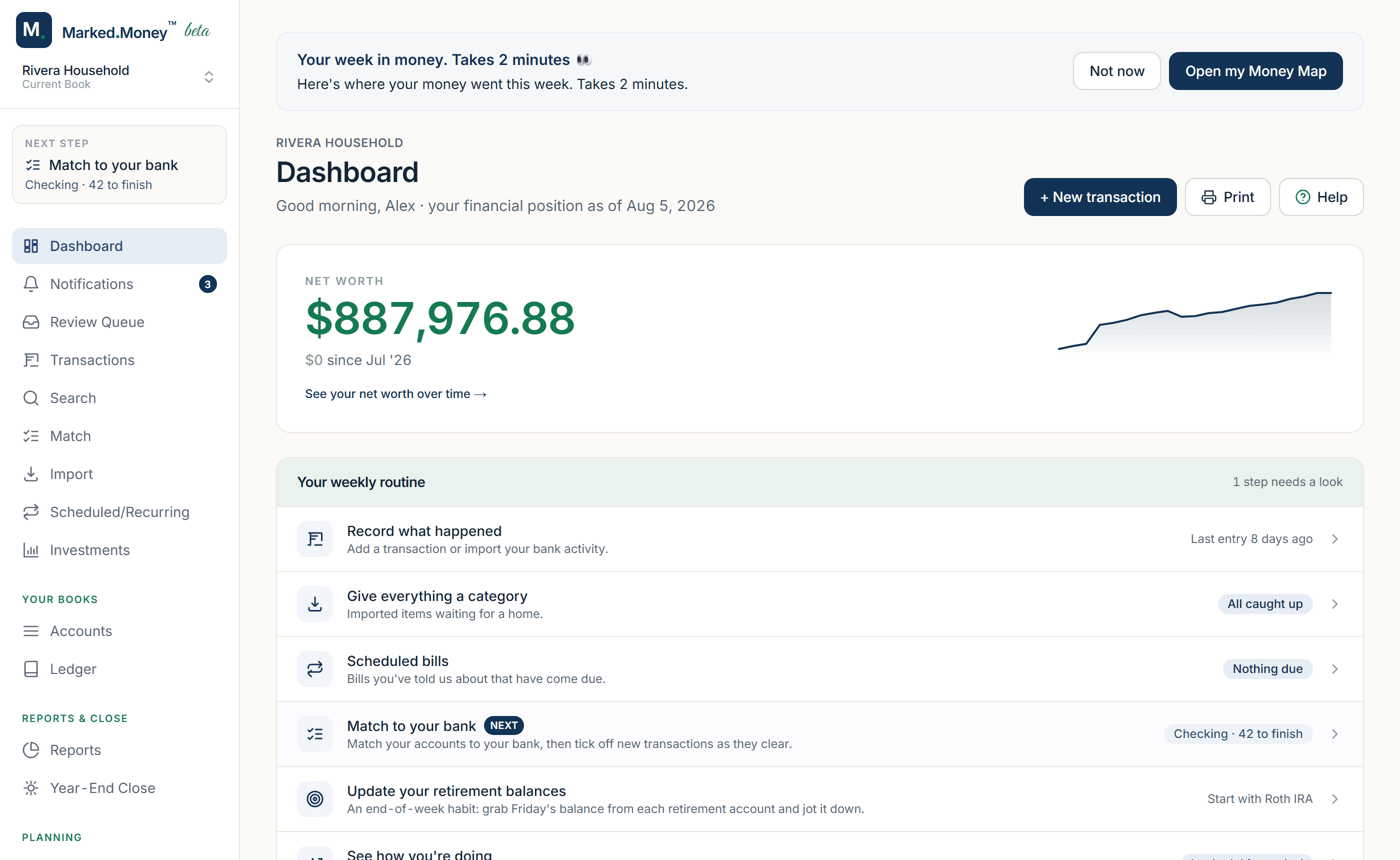
Match to your bank, then lock the month.
Pick a statement, tick off what cleared, and see exactly what’s different. Then lock it in. A settled month stays settled: nothing can quietly change behind a number you already checked. Most money apps have no way to check against your bank at all.
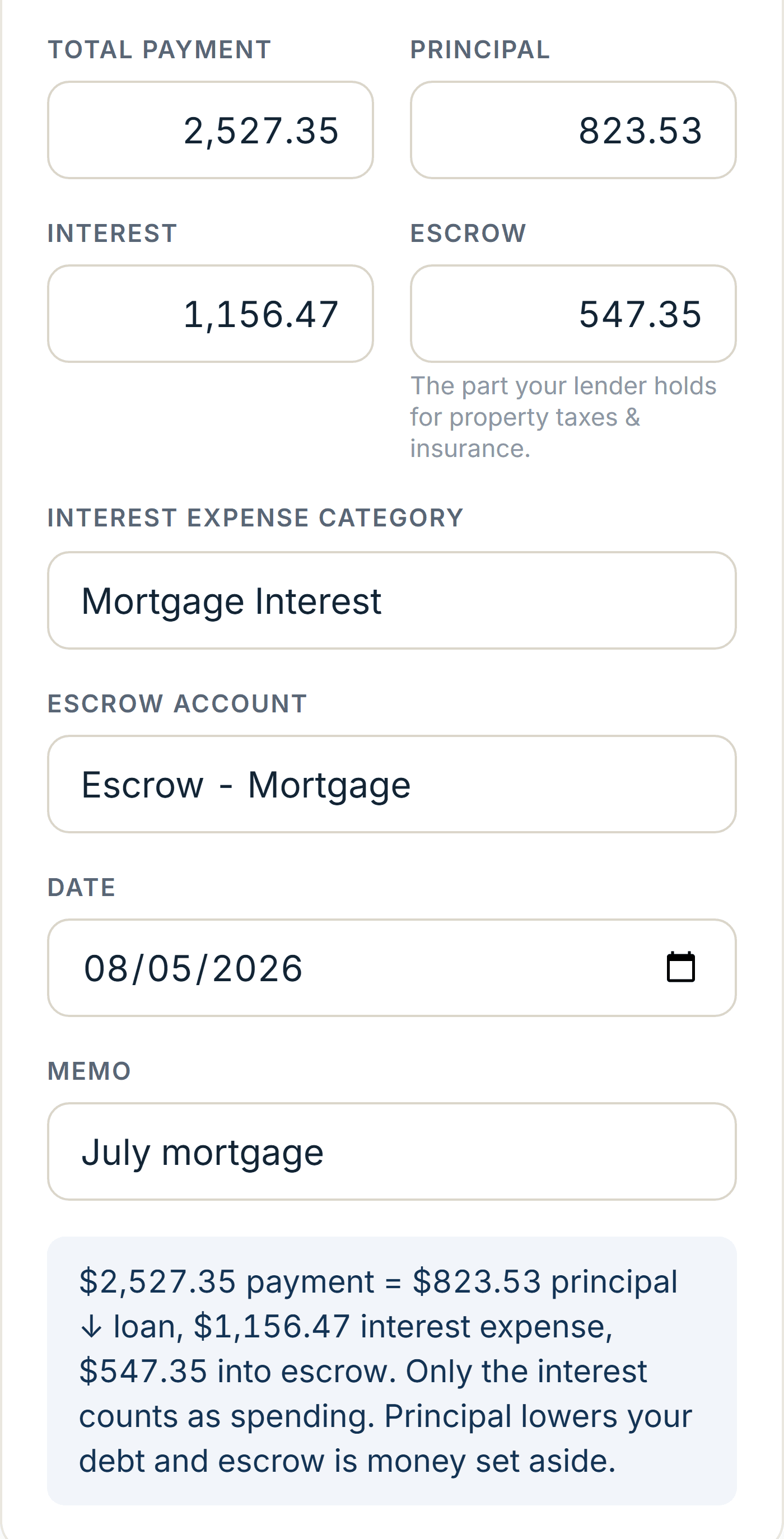
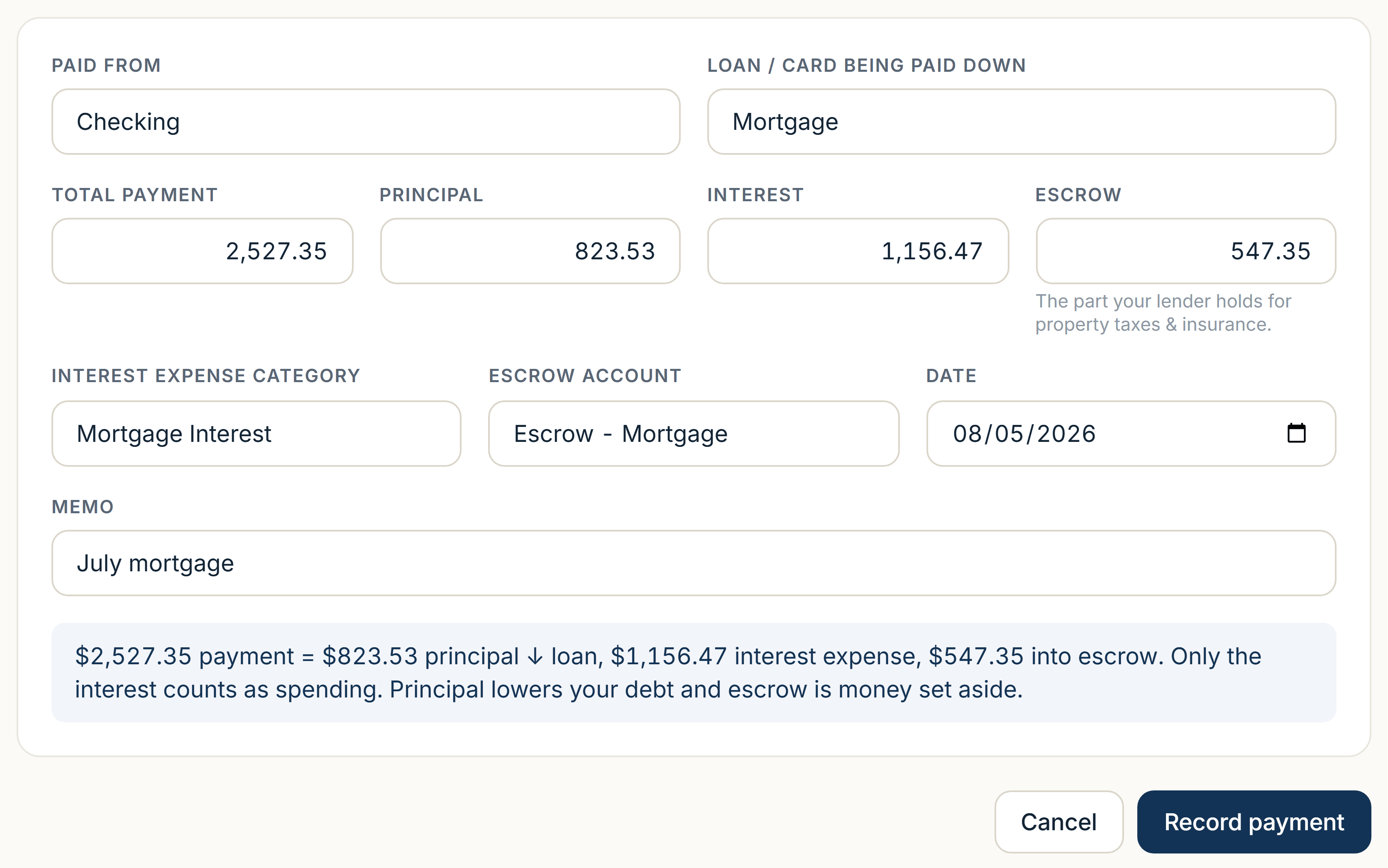
Real entries you can adjust.
Splits, transfers, corrections, and an accountant’s journal entry when the everyday forms don’t cover it. Nothing is stuck and nothing is unfixable, and a correction leaves a record instead of overwriting history.
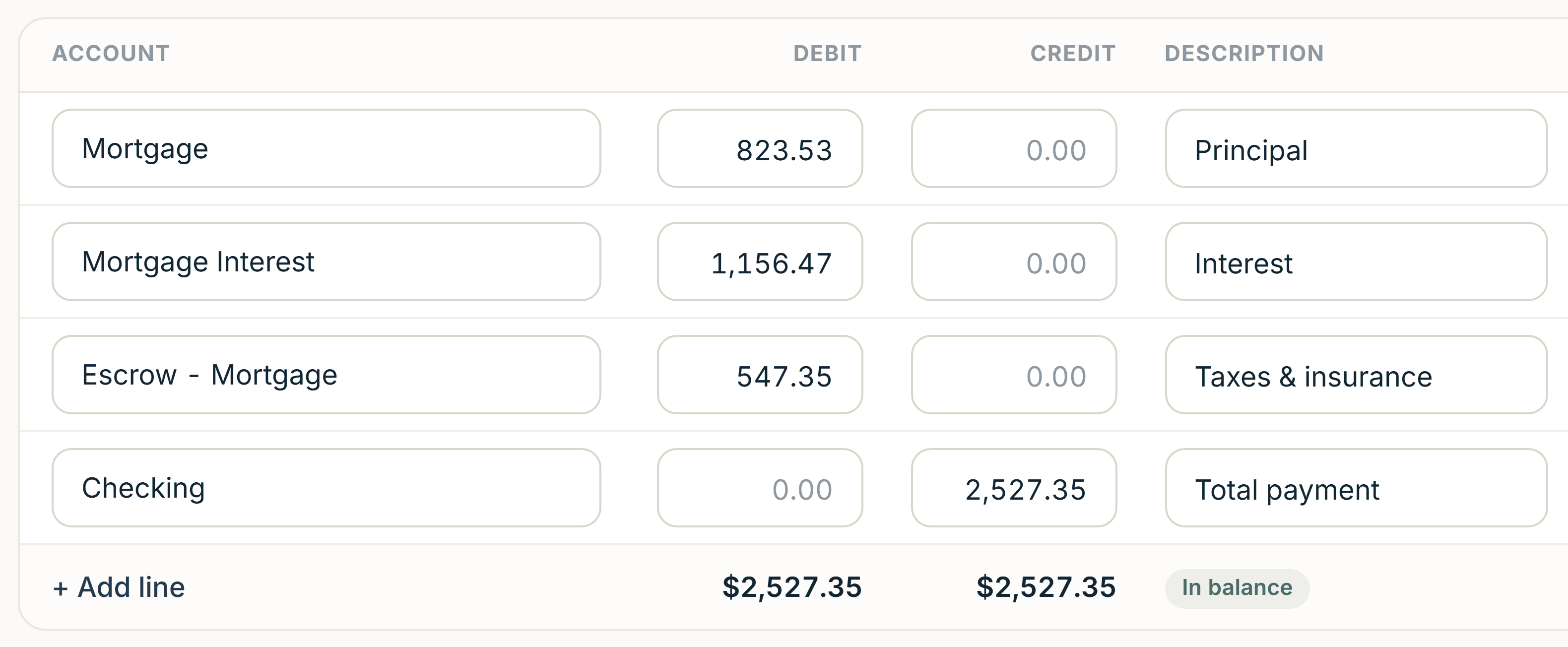
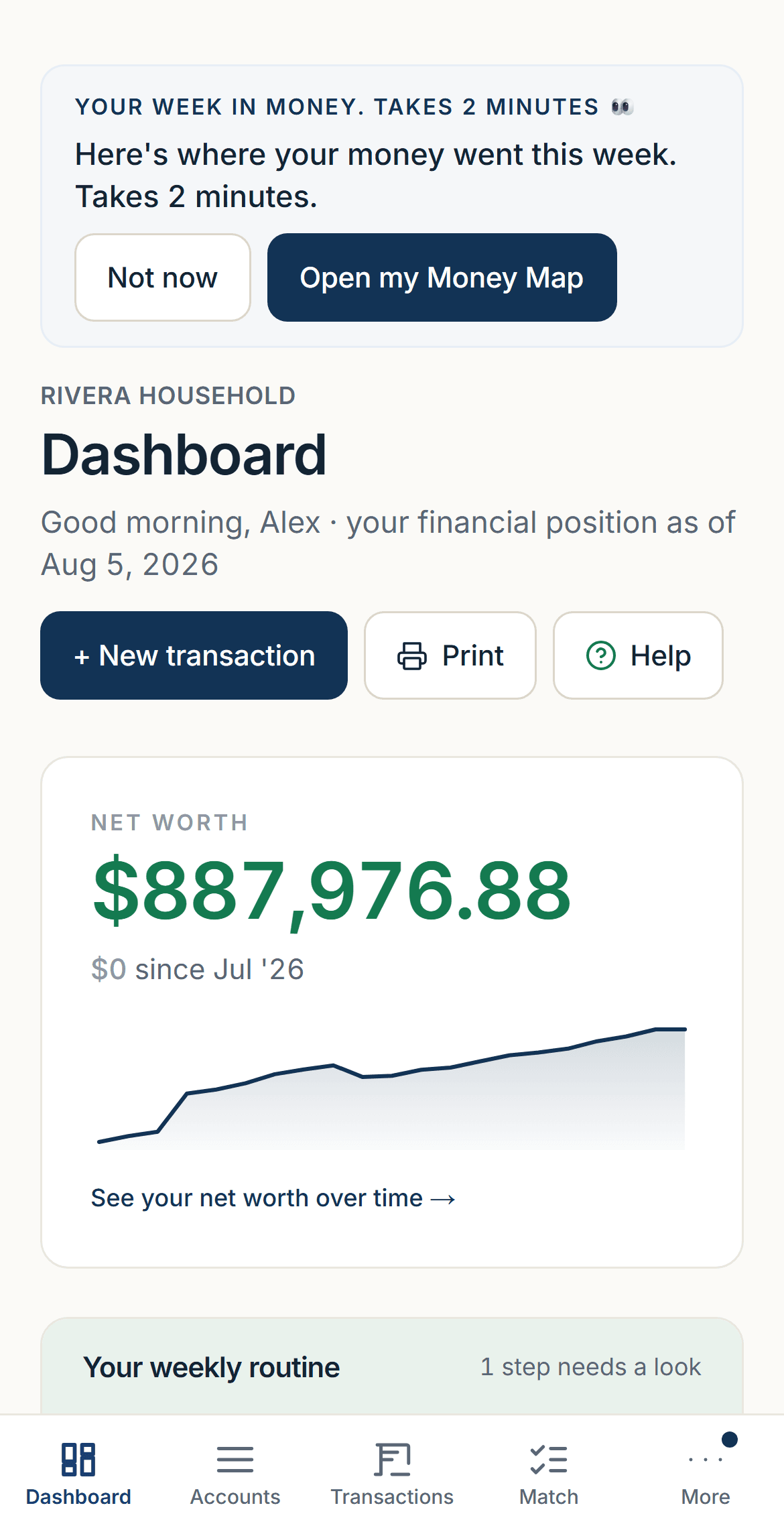
And here’s what that did to your books.
Close the year the way an accountant would.
When a year is done, close it: its income and spending sweep into your net worth, dated December 31, and the new year starts clean. Change something in a closed year later and the books true up with a dated adjustment, balanced either way.
And it goes deeper than that.
K-1s go in.
A trust, partnership, or S corp K-1 you already received, recorded into your own books, with your basis tracked as it moves. Nothing that reads a bank feed can do this, because a K-1 never comes from a bank. See how it works →
Your paycheck, entered properly.
Gross pay, taxes, deductions, and what actually landed, instead of one deposit with no story behind it. Your retirement contribution shows up as savings, which is what it is.
Reports you build.
Pick the accounts you care about, name the report, and run it again whenever you want. It always reads your live books.
Bring your whole history, not a window.
Apps that connect to your bank can only show what their data provider hands back: months by default, two years at the outside. Nothing connects here, so nothing is capped. Import a decade of QuickBooks history and it lands, a year at a time, oldest first. Quicken comes over in a single pass. Running your personal money in QuickBooks? →
A guess is labeled a guess.
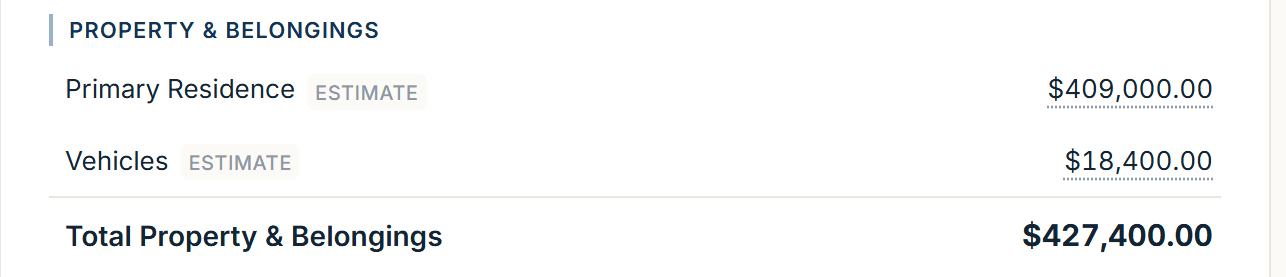
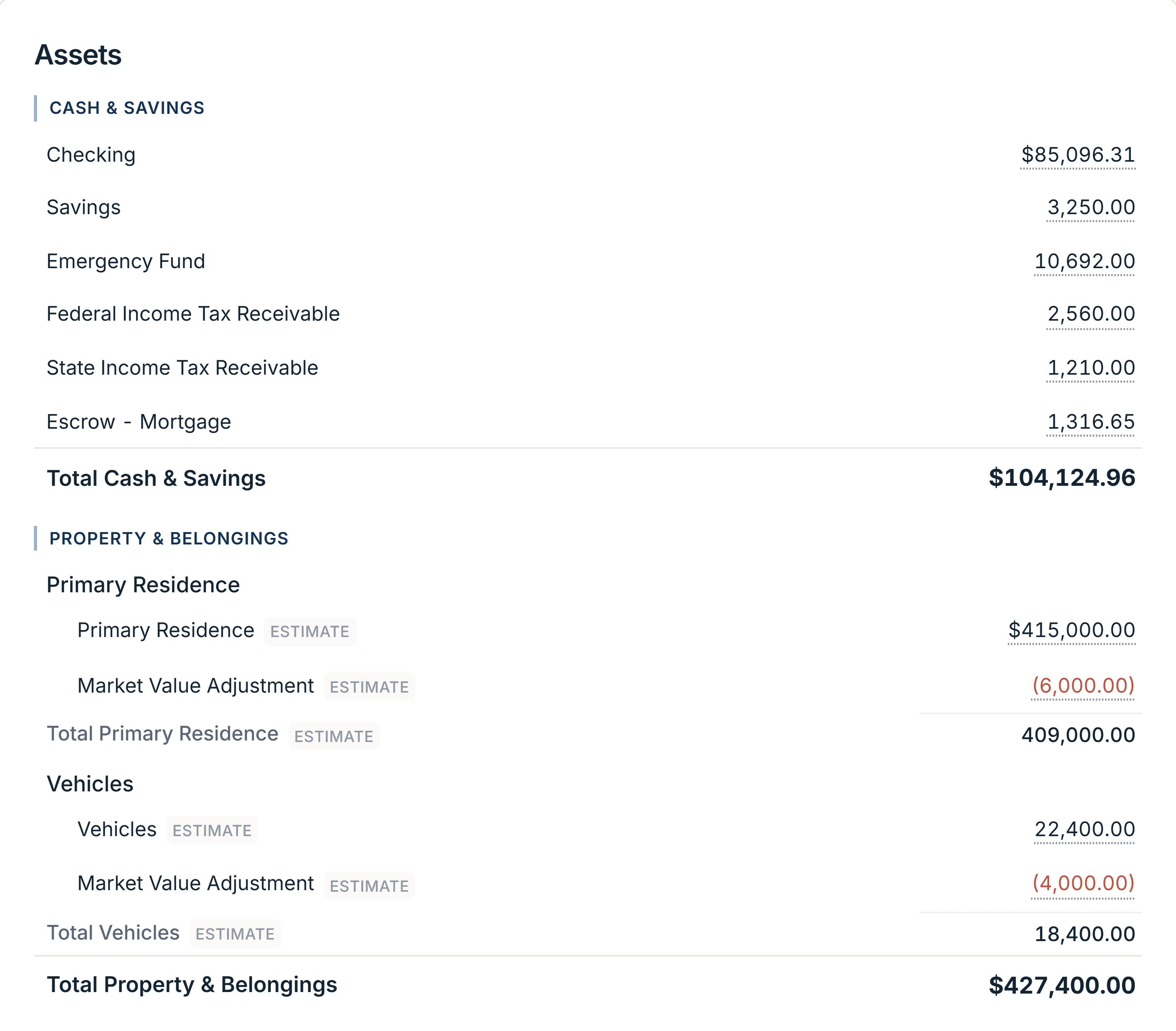
Your house and your car are worth roughly what you think they’re worth, so those rows carry an ESTIMATE tag and the balances you actually counted carry nothing. You can see how much of your net worth was measured and how much is your own best figure. A single number that mixes the two tells you less than it looks like it does.
Nothing links to your bank. Ever.
No credentials, no Plaid, no feed to break at 2 a.m., and no third party holding your financial history. No connection can quietly die and leave you looking at stale numbers. You import a file from your bank or add it yourself, and you confirm it before it counts.
No ads. We don’t sell your data. Ever.
There is no ad business here, and no data broker on the other end of one. Nothing you enter is sold, shared, or used for anything but showing you your own money. It isn’t a setting you have to go and find, and it isn’t the free-for-now version of a plan that changes later. It’s in the Privacy Policy, which is the part that binds us.
More on how the measurements work, each with the whole story: the Learn essays.
How the rhythm works
Ten minutes, once a week.
Bring in the week’s activity, confirm what’s yours, and you’re done. Real double-entry accounting keeps everything balanced underneath, with plain English on top and an accountant’s view when you want it.
- Jul 2KROGER #123−$82.45Groceries
- Jul 3LEXSERV WATER−$68.24Utilities
- Jul 5TRANSFER TO SAVINGS−$500.00Transfer
- Jul 6SMOOTH TRANSITIONS−$448.12Choose category…
Illustrative. Nothing posts until you confirm it.
Marked Money teaches while you work.
Why that entry moved two places at once. What a category is actually costing you over a year. What “equity” means when it’s your house and not a textbook. You come out understanding the machinery, not just staring at the output.
$500 left Checking and arrived in Savings. Your net worth didn’t change, only where the money sits. That’s why a transfer never counts as spending.
Illustrative. Explanations appear in context, as you work.
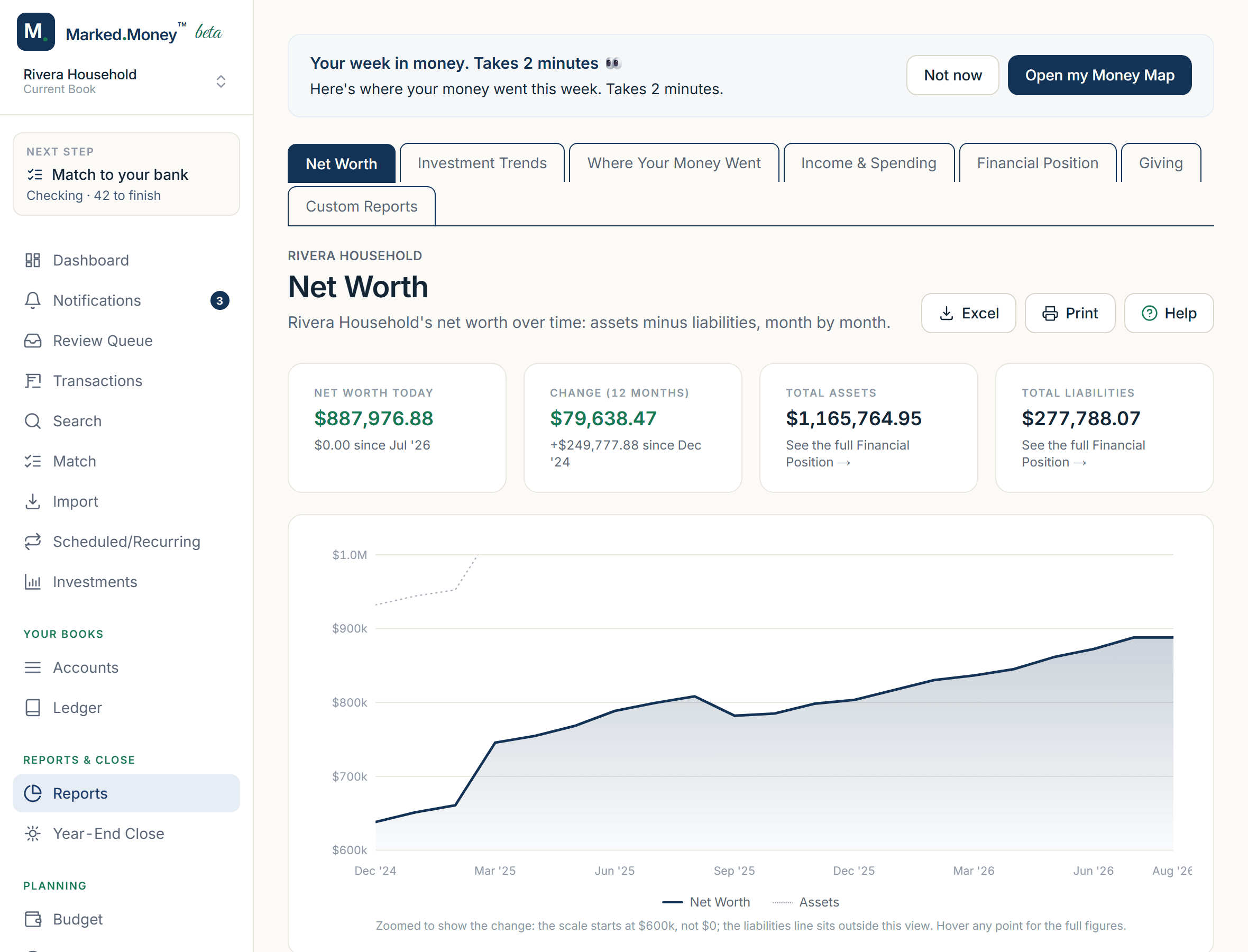
Then the trend does the talking.
Net worth climbing, and you know which decision did that. Slipping, and you get the signal early, with a report that shows you what moved the needle, not just that something did.
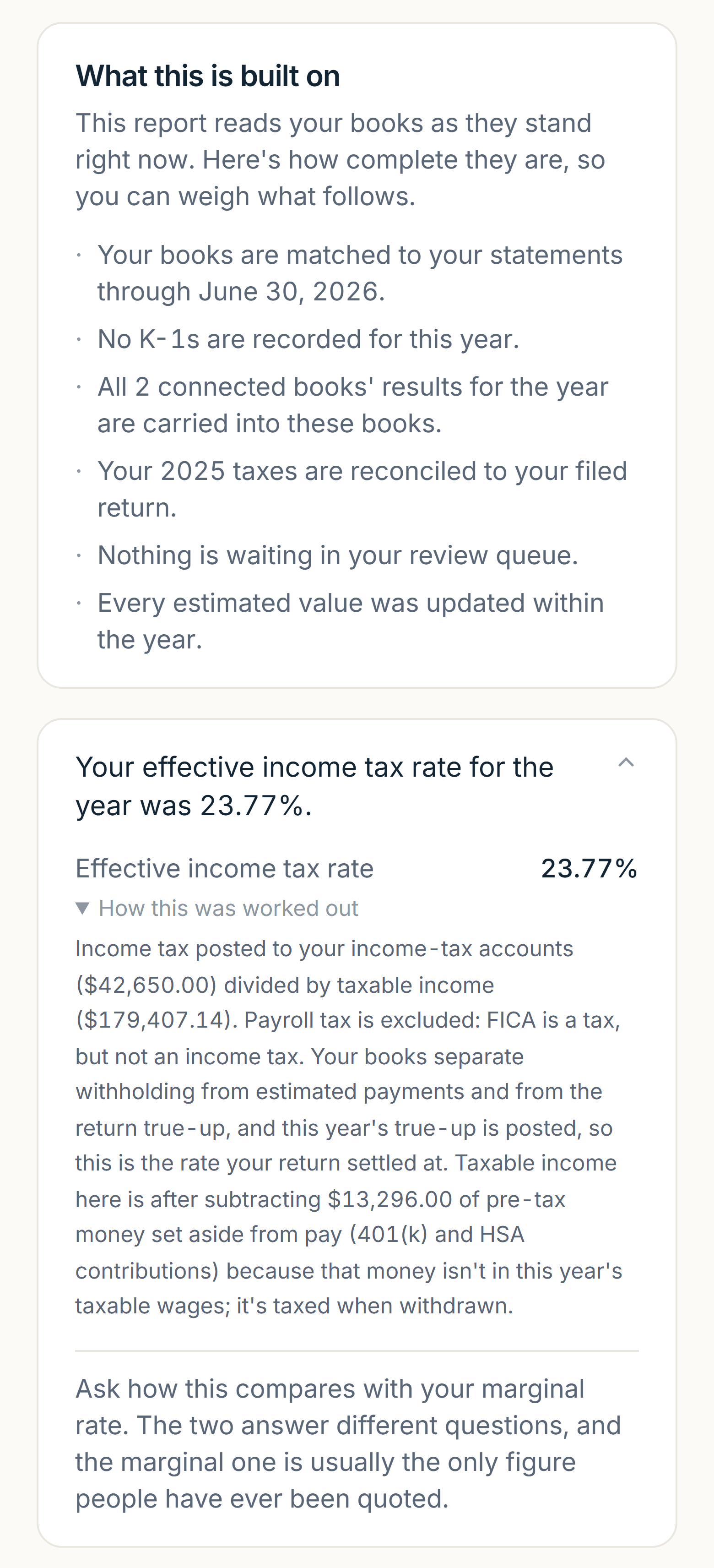
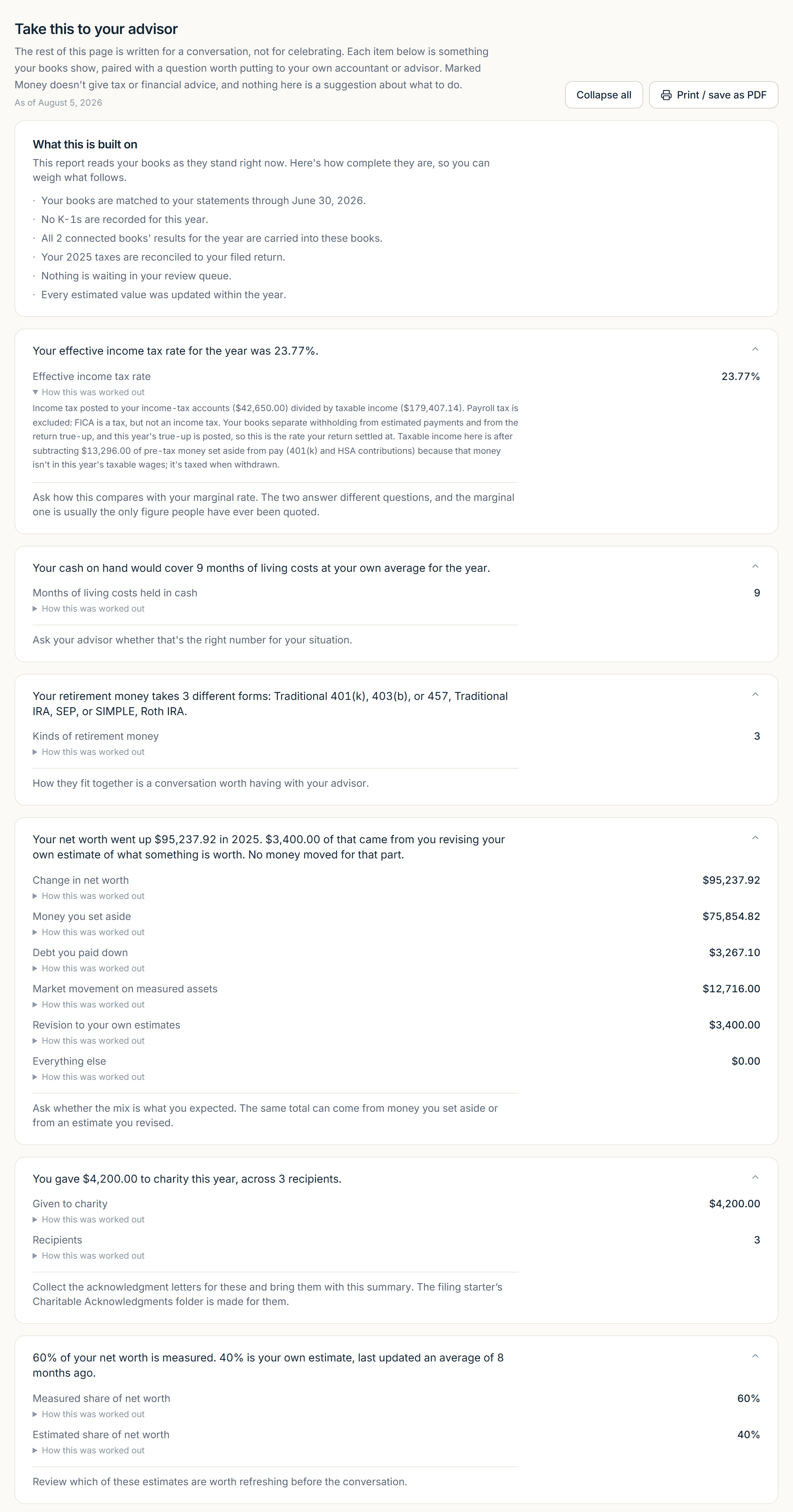
At the end of the year, hand your accountant the year.
Marked Money assembles a year-end summary written for a conversation with your own CPA or advisor: what changed, what it’s built on, how complete your books are, and the questions worth asking. Every figure shows how it was worked out. Nothing in it is advice.
Now: your rentals and your business
If you run a rental or a small business of your own, you know the split-screen problem. Personal money in one app, business money in another, and no single number that tells the whole truth.
Marked Money now carries real books for all of it: personal, rental, business. One place, rolling into one net worth you can actually stand behind. Your entire financial picture, visible.
See how the books workAvailable now, in the beta.
Why I built this
I’m a CPA. Twenty-five years of telling people the truth about their numbers.
And for a long stretch, I couldn’t have told you mine. Not really. I had the apps. Everything linked, everything synced, everything categorized for me. And I stopped looking. Bank feeds made me lazy. The picture on my screen was assembled by software I didn’t check, from categories I didn’t choose, and when I looked at my own net worth I felt exactly what my clients felt: that’s probably about right.
Probably about right is not a thing a CPA should say about his own money.
So I built the tool I couldn’t buy. Real accounting underneath, because that’s the only way the numbers hold together. Nothing linked, because the linking is what let me check out. And honest labeling on every estimate, because the fastest way to lose trust in a number is to dress up a guess as a fact.
I use it every week. That’s the whole test I hold it to.
Under all of this sits tax machinery most CPAs don’t build twice: partnership basis, trusts, depreciation. You’ll never see it. It’s why the simple numbers are right.

— Mark Wadlington, CPA
About the beta
It’s free right now, and it stays free while the beta lasts.
When Marked Money leaves beta, the first 100 accounts keep every feature, both tiers, at a founding-member price of $99 a year, locked for as long as you keep your account. You’ll never be charged without explicitly choosing to pay, and you can take your books with you at any time.
The founding price covers the full personal product, both tiers, including features added to them later. It doesn’t cover separate products built for professional advisors.
It’s also honestly beta. There are rough edges. Some screens are prettier than others. If you find something broken, tell me and I’ll fix it. You’ll be talking to the person who wrote the code.
What’s true today: Real double-entry accounting. No bank linking. Accountant’s view toggle. Every entry balances and every account reconciles, with measured figures and your estimates clearly labeled. U.S. dollars only. Real books for rentals and small businesses, rolling into one net worth. Share a set of books with the people you share money with, so you’re all looking at the same accounts and balances. Export your data anytime, in a format you can actually use.
What isn’t here yet: Mobile apps. Multi-currency. Books that split ownership. A partnership, or any business with more than one owner, needs a capital account for each of them, and these books keep one.
I’d rather tell you that now than have you find out in week three.
Ten minutes a week. Confidence that compounds.
Set up your accounts, enter your opening balances, and bring in your first month. Give it your ten minutes each week after that. By the third or fourth pass, you’ll notice you’re not guessing anymore.
Free during beta · No bank linking · Export anytime